The AI adoption dashboard is a reassuring object.
Licences allocated. Weekly active users rising. Pilot launched. The slide turns green.
Then comes the impolite question: did the work itself get any better?
Generative AI adoption at work has become broad without becoming deep. People use the tools to draft, search, summarise and think. Yet occasional assistance is not the same as an organisational capability. Access can create activity. It cannot, by itself, create a repeatable workflow, a shared quality standard or a body of learning that survives the next prompt window.
Most AI programmes can tell you who has access. Far fewer can tell you what the organisation has learnt.
What does the latest evidence say about generative AI adoption at work?
The newest US evidence gives this problem a useful shape.
A September 2026 NBER working paper by Alexander Bick, Adam Blandin, David Deming and Tyler Schumacher draws on a nationally representative survey of nearly 14,000 workers across four waves between August 2025 and May 2026. The researchers linked workers not merely to occupations, but to the detailed tasks they perform.
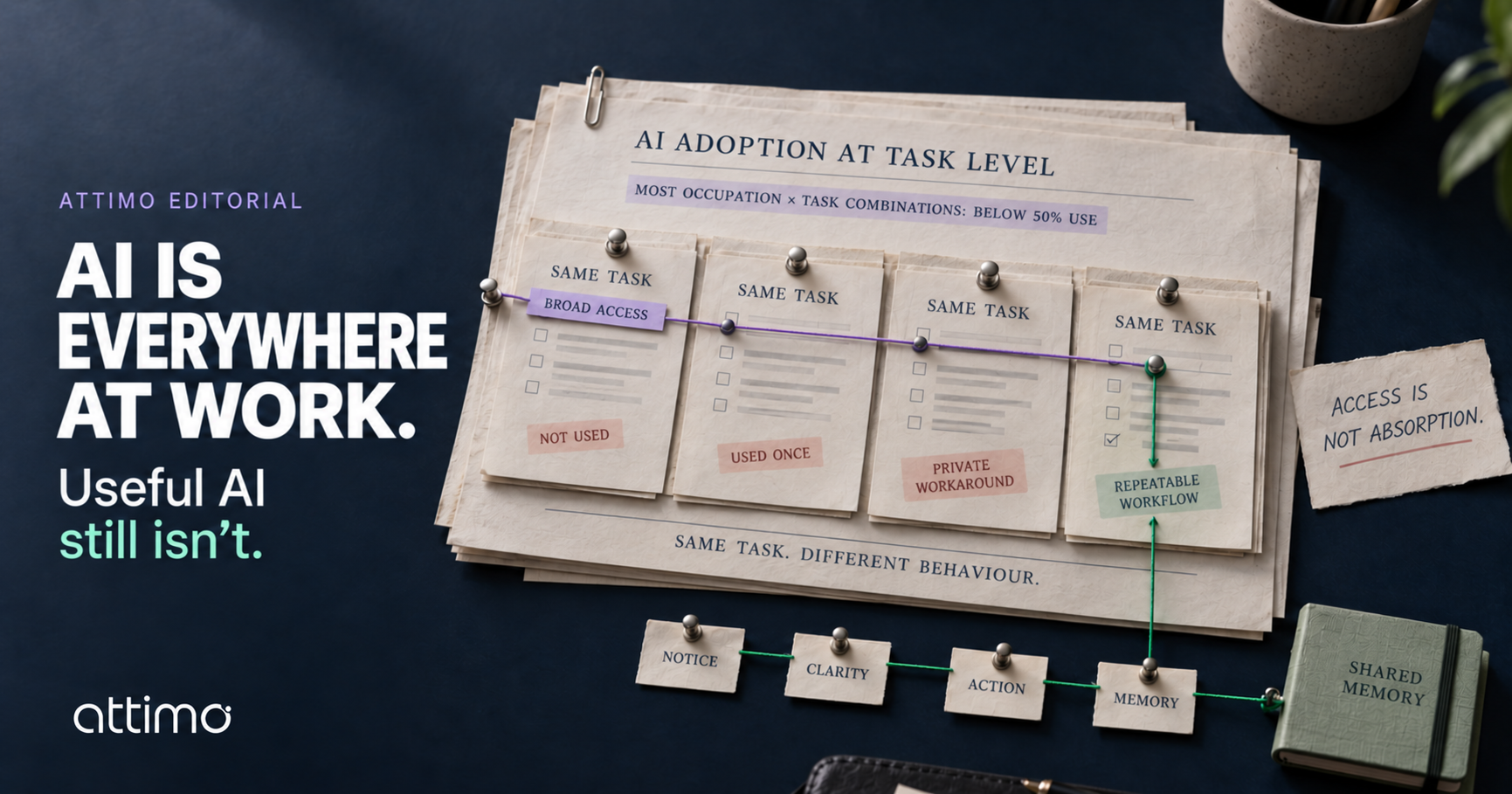
They found AI use in more than 80% of occupations and across more than 40% of job tasks—if the threshold is set at one worker in five. Raise the threshold, however, and the map changes. Only 40% of occupations had adoption above 50%. Fewer than 3% of tasks did.
The researchers' phrase for it is admirably plain: “widespread but shallow”.
The accompanying Federal Reserve Bank of St. Louis analysis shows how quickly the surface area has grown. Between August 2024 and May 2026, the share of US workers using generative AI for their jobs rose from 33% to 45%.
At this point, AI is less a visitor to the workplace than a colleague with an unclear job description.
There are two necessary cautions. This is US survey evidence, not a universal map of every labour market. And it measures reported use, not value. A prompt entered is not proof that quality improved, risk fell or a customer received a better outcome. “People used the tool” is the beginning of the inquiry, not the conclusion.
Why does AI access fail to become a real workflow?
The NBER paper's more interesting finding sits below the adoption headline. Technical exposure helps explain which occupations and tasks use AI, but it is a poor guide to whether a particular person will use it. Two people doing similar work can behave quite differently.
That gap is where organisational readiness enters. The possibility of using AI is only one condition. People also need permission, relevant context, a reason to trust the output, time to learn and a workflow in which the tool has a defined role. The researchers found patterns consistent with costly learning: people with more experience of generative AI tended to use it across more of their work. Familiarity compounds, but someone has to pay for the first round of experimentation.
Microsoft's 2026 Work Trend Index points in the same direction. It surveyed 20,000 AI users across ten countries and found that organisational factors—including culture, manager support and talent practices—had more than twice the relative importance of individual factors in explaining reported AI impact: 67% against 32%.
That result is an association in self-reported data, not proof of cause and effect. But its summary is hard to improve upon: “In many cases, people are ready. The systems around them are not.”
Gallup supplies another warning light. In its Q2 2026 US employee data, 47% of workers said their organisation had begun integrating new AI tools. Only 25% strongly agreed that it had communicated a clear plan or strategy for doing so.
In other words, the software can arrive well before the operating instructions.
Five failures repeatedly keep AI use shallow:
- No workflow home. AI is available everywhere but belongs nowhere in the actual process.
- No shared quality bar. Each person privately decides what counts as accurate, safe or finished.
- No managerial permission. Leaders request adoption but provide no time to learn, test or challenge the tool.
- No persistent context. The worker must rebuild the brief, constraints and history in every session.
- No organisational memory. A useful discovery remains one person's clever prompt rather than becoming reusable knowledge.
The organisation has purchased intelligence and assigned integration to whoever happens to have a quiet Friday.
What is the difference between AI adoption and AI absorption?
AI adoption asks whether people use the capability. AI absorption asks whether the organisation has integrated it into repeatable workflows, decision rights, standards and learning.
Frequency alone is not enough. A tool can be used every day and still remain shallow if context is rebuilt from scratch, quality depends on private judgement and nothing useful is retained for the next person.
| The question | Shallow adoption | Organisational absorption |
|---|---|---|
| What proves success? | An account is active | A target workflow improves repeatedly |
| Where does AI sit? | Beside the work | Inside a defined part of the workflow |
| How is context handled? | Rebuilt for each prompt | Carried forward and kept traceable |
| Who judges quality? | Each user improvises | Standards and human ownership are explicit |
| What happens to learning? | It stays with the individual | It becomes reusable organisational memory |
This is why Attimo treats attention as the operating system behind an organisation. A meaningful moment in work has to complete a cycle:
- 01Notice: surface the signal worth acting on, rather than adding another stream of noise.
- 02Clarity: bring forward the context, intent and quality threshold needed to understand it.
- 03Action: help the work move inside a real process, with ownership kept by the right person.
- 04Memory: preserve the decision, evidence and outcome, so the next cycle does not begin from nothing.
Useful AI does not merely produce an answer. It helps the work move, preserves human authorship and leaves the organisation wiser than it was before.
How can an organisation turn AI access into useful AI?
Start smaller than the keynote speech.
Choose one consequential workflow and describe how it works now: the signal that begins it, the context people need, the decisions they make, the exceptions they encounter and the evidence they must retain. Then decide where AI genuinely reduces cognitive load—and where friction is doing the valuable work of judgement.
Five practical moves follow:
- Name the workflow, not merely the tool. “Use AI more” is not an operating model. “Prepare the first review pack from approved sources, with citations and an accountable reviewer” is much closer.
- Define the hand-offs. State what the system may organise, suggest or draft; what a person must interpret or approve; and what happens when confidence is low.
- Give the system governed context. Useful outputs depend on current sources, visible constraints and version control—not on the employee remembering which attachment was final-final-v7.
- Set the quality bar before scaling. Specify the evidence required, the errors that matter and the person who owns the outcome.
- Keep what the work teaches you. Corrections, exceptions and good decisions should improve the next cycle, rather than disappearing into private chat histories.
The aim is not maximum automation. It is dependable assistance around moments where attention, context and judgement matter.
How should organisations measure AI adoption?
A dashboard can count prompts. It cannot tell you whether Tuesday got any easier.
Licence activation, active-user counts and prompt volume remain useful operational signals. They simply do not establish that work improved. A better scorecard measures depth and consequence:
- Workflow depth: what proportion of target workflows are in repeated, sustained use rather than one-off trials?
- Context cost: how much time do people spend reconstructing the brief before useful work can begin?
- Hand-off quality: are human-to-AI and AI-to-human hand-offs complete, legible and owned?
- Corrections and exceptions: do error, rework and escalation rates improve as use increases?
- Knowledge retention: how much useful learning is captured in a form that colleagues can reuse?
- Human accountability: can everyone see who remains responsible for the decision or action?
- Work outcomes: is there measurable movement in quality, cycle time, risk, cost or customer experience?
These are diagnostic measures, not a universal maturity model. The right outcomes vary by workflow. The principle does not: judge adoption by the change in work, not the quantity of software activity surrounding it.
Useful AI is a property of the system
Return to the green dashboard. Licences can be purchased centrally. A pilot can launch on schedule. Absorption is slower because the organisation itself has to learn: where AI belongs, what evidence is sufficient, when a person must decide and how a useful discovery becomes shared memory.
That does not make today's adoption meaningless. It makes the next step clearer.
The challenge is no longer getting AI through the door. It is designing the conditions in which it becomes useful without losing judgement, context or responsibility.
Adoption is the arrival of software. Absorption is the organisation learning how to work differently.
Explore how Attimo builds human-first AI around the real workflow.
Frequently asked questions
Why is generative AI adoption at work still shallow?
Access is spreading faster than workflow redesign. Many employees can use generative AI, but lack a defined place for it in the process, shared quality standards, persistent context, managerial support and a way to retain useful learning. Use therefore remains occasional or personal rather than repeatable and organisational.
What is the difference between AI adoption and AI absorption?
AI adoption measures whether people use a capability. AI absorption describes the point at which that capability becomes part of how an organisation repeatedly notices, understands, acts and learns. Absorption requires workflow integration, clear ownership, quality standards and shared memory; it is not the same as frequent prompting.
What is organisational AI readiness?
Organisational AI readiness is the extent to which leadership, culture, management practices, governance, skills and workflows allow people to use AI safely and productively. It is not simply technical availability. A ready organisation gives AI a defined role, establishes human accountability and learns from real use.
How should organisations measure AI adoption?
Measure sustained use in target workflows and the outcomes around it: time spent rebuilding context, hand-off completeness, error and rework rates, captured learning, accountable human ownership, quality, cycle time and risk. Licence activation and prompt volume show activity, but do not prove value.
What does good AI workflow integration look like?
Good AI workflow integration gives the system a specific job, reliable context, clear limits and an accountable human owner. Inputs and sources are visible; low-confidence cases can be escalated; quality is evaluated; and useful corrections are retained so that future work improves rather than starting again.
Sources
- NBER Working Paper 35677Alexander Bick, Adam Blandin, David J. Deming and Tyler Schumacher, What Work Does Generative AI Do?, September 2026.NBER
- Federal Reserve Bank of St. LouisWhat Work Does Generative AI Do?, 1 September 2026.St. Louis Fed
- Microsoft2026 Work Trend Index Annual Report: Agents, Human Agency, and the Opportunity for Every Organization, 5 May 2026.Work Trend Index
- GallupA People-First Approach to AI Adoption, Q2 2026 US employee data.Gallup Workplace
- AttimoStay in the moment, accessed 8 September 2026.Attimo