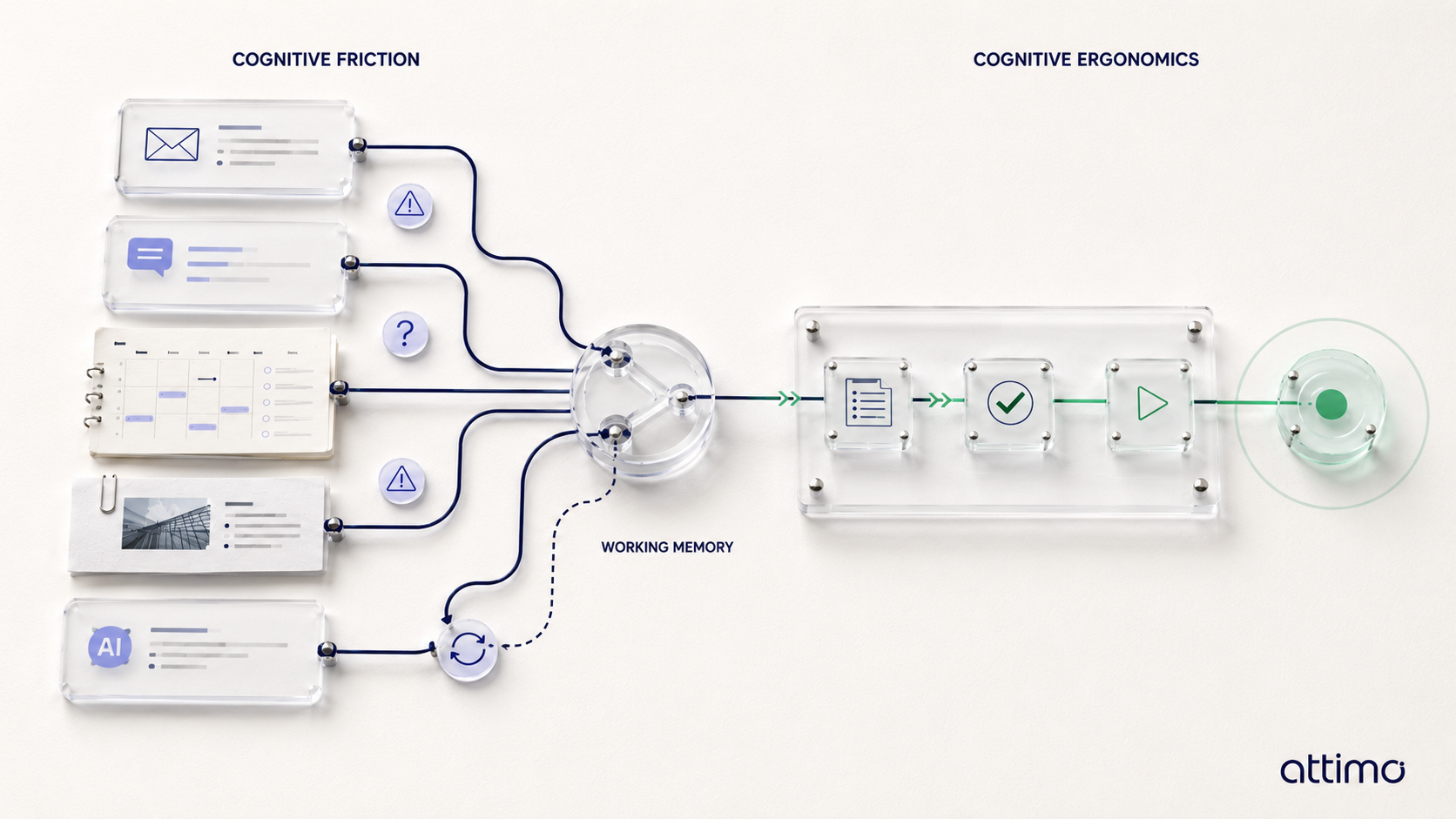
For decades, enterprise ergonomics focused on the physical body: adjustable chairs, monitor heights, and split keyboards designed to prevent repetitive strain. But as knowledge work shifts toward AI-driven digital ecosystems, the primary friction point in the modern enterprise is no longer physical.
It is cognitive.
Information workers now navigate an environment filled with constant notifications, real-time context switching, and complex software interfaces. We were promised that artificial intelligence would eliminate repetitive tasks and reduce stress. Instead, many organisations face the Cognitive Friction Paradox: the more tools we introduce to automate work, the more mental energy employees burn simply managing, verifying, and switching between those tools.
To build sustainable, high-performing organisations, enterprise design must evolve from physical ergonomics to Cognitive Ergonomics.
What is Cognitive Ergonomics?
Cognitive Ergonomics is the discipline of designing systems, software, and workflows to align with the natural architecture of human cognition. Grounded in cognitive psychology and human-computer interaction (HCI), it focuses on how mental processes - such as perception, working memory, decision-making, and attention - are affected by interactions with complex environments.
While physical ergonomics asks: "Does this chair support the human spine?"
Cognitive ergonomics asks: "Does this system respect the limits of human working memory?"
In a traditional work environment, human working memory can hold only a limited number of items simultaneously. When software platforms force workers to constantly interpret unverified data, re-learn shifting user interfaces, and cross-reference disconnected communication channels, the brain reaches cognitive overload.
The 3 Hidden Drivers of Cognitive Exhaustion in AI Environments
As enterprise adoption of generative AI and automation accelerates, three primary friction points hinder productivity:
1. Context-Switching Fatigue
The average knowledge worker switches between disparate applications dozens of times an hour. Every transition requires the brain to dump its active mental model and rebuild a new one. This repeated recalibration drains mental energy, leading to decision fatigue and higher error rates late in the workday.
2. Verification Burnout and Automation Bias
When AI systems operate as ungoverned "black boxes" - generating text or modifying data without clear citations - humans are forced into an exhausting state of perpetual auditing. Alternatively, workers succumb to automation bias, blindly accepting unverified outputs to save mental energy. Research published by MDPI highlights that over-reliance on generative AI without structured boundaries amplifies cognitive strain rather than reducing it. True cognitive ergonomics eliminates this dilemma by providing transparent evidence trails and clear confidence metrics directly within the workflow.
3. Unstructured Cognitive Offloading
Cognitive offloading occurs when humans rely on external tools (like notebooks or digital assistants) to reduce working memory load. However, studies indexed on PMC / National Institutes of Health demonstrate that when digital interactions are poorly structured, offloading backfires. Instead of freeing up mental bandwidth for strategic thinking, workers waste energy managing the tool itself.
Designing for the Mind: The Attimo Perspective
Attimo was founded on a core principle: Technology should adapt to human cognitive architecture - not the other way around.
Creating a cognitively ergonomic work environment requires moving away from fragmented, high-friction software toward unified execution layers that preserve human focus:
-
Eliminating Context Drift: Work environments must centralise background context, past decisions, and dynamic project dependencies into a living memory so workers don't have to carry the mental load manually.
-
Deterministic Transparency: AI systems must operate on a clear Propose-Confirm-Materialise framework, presenting human leads with explicit citations and confidence scores so verification takes seconds rather than hours.
-
Preserving Strategic Focus: By designing digital environments that respect human working memory limits, teams preserve high-level creative thinking, critical judgment, and strategic problem-solving.
The Strategic Advantage of Cognitively Ergonomic Systems
Organisations that prioritise cognitive ergonomics gain a distinct operational advantage:
- Reduced Human Error: Systems designed to match human cognitive capacity dramatically reduce oversight errors caused by fatigue and information overload.
- Accelerated Onboarding: When software environments mirror natural human mental models, new team members reach full productivity faster without facing steep learning curves.
- Sustained Innovation: Protecting employees from routine mental friction unleashes the cognitive bandwidth required for deep work, complex reasoning, and long-term innovation.
The future of enterprise software is not about piling on more tools or generating endless text. It is about building cognitively ergonomic environments that harmonise human intelligence with intelligent execution.
Frequently Asked Questions (FAQ)
What is the difference between physical ergonomics and cognitive ergonomics?
Physical ergonomics focuses on the physical interaction between humans and their equipment (e.g., posture, seating, physical strain). Cognitive ergonomics focuses on mental processes - such as working memory, attention, perception, and decision-making - to ensure systems do not overload human mental capacity.
How does cognitive friction impact workforce productivity?
Cognitive friction occurs when software tools force users to perform unnecessary mental effort, such as constant context switching, searching for lost information, or manually verifying unvetted outputs. This causes mental fatigue, higher error rates, decision paralysis, and burnout.
How does cognitive ergonomics improve AI adoption in the enterprise?
By introducing clear governance frameworks, inline citations, and human-in-the-loop confirmation, cognitive ergonomics removes the anxiety and verification fatigue associated with "black-box" AI. This allows teams to safely trust and adopt automated workflows without sacrificing control.
External references
- MDPI Journal of SystemsGenAI & Cognitive Strain Study
MDPI
- PubMed CentralHCI & Cognitive Load Classification Research
PMC / National Institutes of Health
- ResearchGateHuman-AI Decision Making & Cognitive Ergonomics
ResearchGate