The org chart still shows marketing over here, finance over there and legal in a room whose door opens only after a calendar invitation. The work has already become less obedient.
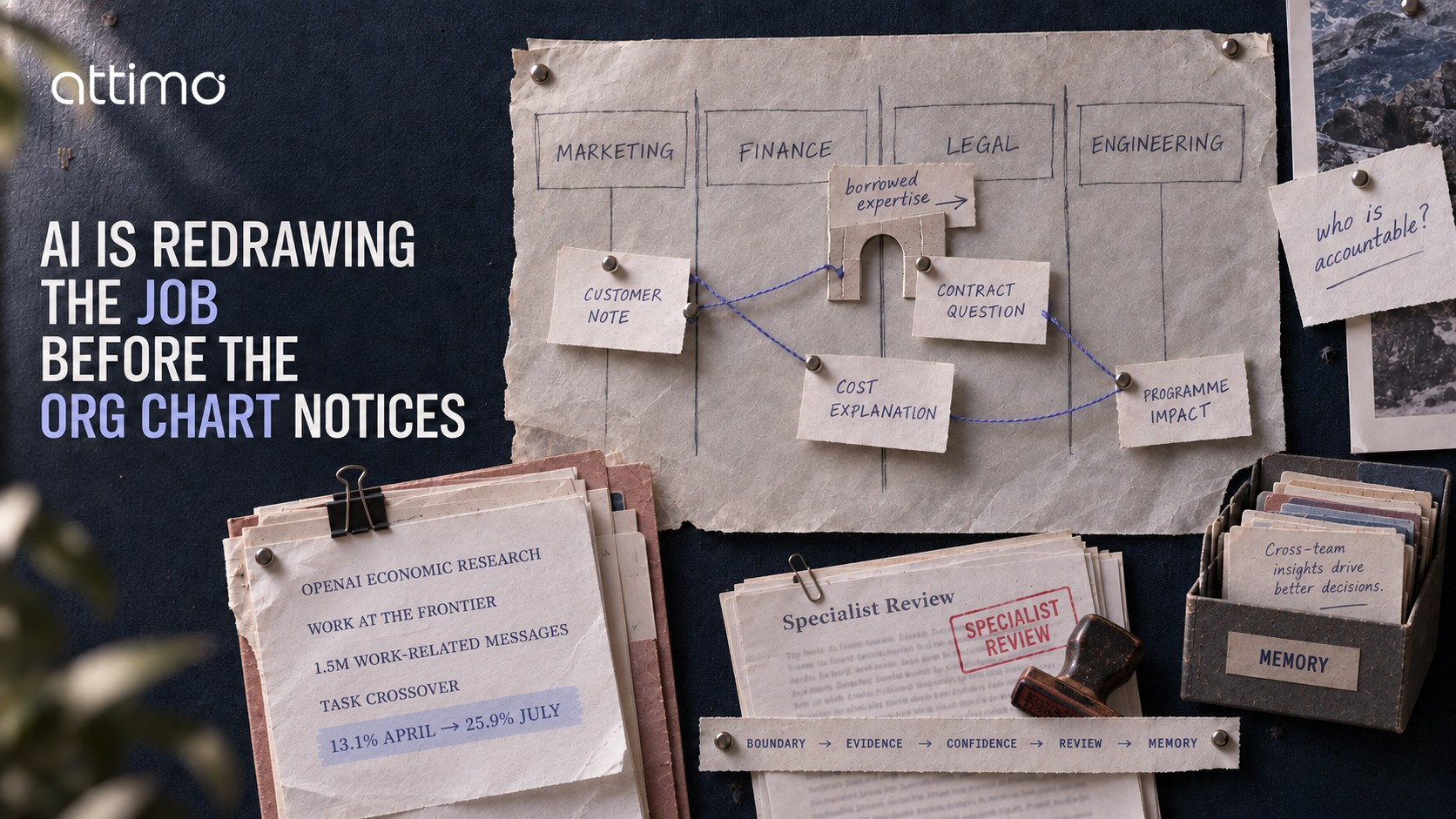
In September, OpenAI Economic Research published an analysis of more than 1.5 million work-related ChatGPT messages. It found that workers are increasingly using AI for tasks outside their traditional occupations. Among a consistently observed group of roughly 6,200 workers, recurring cross-occupation tasks grew from 13.1% of their occupation-specific AI activity in April to 25.9% in July.
The job title did not change. The job did.
The rise of borrowed expertise
OpenAI calls the pattern "task crossover". A marketer researches a contractual question. A project manager drafts customer communications. An engineer prepares a financial explanation. The worker brings the context; the model supplies some of the specialist language, structure or reasoning.
This is not the familiar story about AI saving ten minutes on an email. It is a reallocation of capability.
The study suggests that workers approach unfamiliar work differently. Their cross-occupation prompts were less likely to request explanations, advice or a particular format. They were more likely to provide background and seek checking or verification. The authors cautiously describe this as workers "borrowing expertise".
That phrase is useful because borrowing is not ownership. You can borrow a ladder without becoming a roofer. You can also reach a place you could not reach before, which is both the opportunity and the reason to inspect the ground.
The missing signal
Traditional organisations make professional boundaries conspicuous. A hand-off to legal is slow, but everyone knows a legal judgement is being made. A cost plan arrives from a quantity surveyor with a name attached. A drawing is issued at a revision, under a process, by a person whose authority is understood.
AI can remove the friction from crossing those boundaries. It can also remove the signal that a boundary has been crossed.
That matters because fluency is not the same as warrant. An answer can look native to a profession while lacking the local knowledge, tacit experience or duty that gives professional judgement its value. The danger is not simply that the answer might be wrong. It is that the surrounding workflow may no longer tell us when a specialist should enter.
The better question, then, is not whether people should use AI outside their expertise. They already are. It is how the work should behave when they do.
Adoption is an organisational design problem
The 2026 Microsoft Work Trend Index reaches a related conclusion from a different direction. Its analysis found that organisational factors accounted for twice the reported AI impact of individual effort. Among the capabilities respondents considered important, quality control and critical thinking ranked prominently. Most users treated AI output as a starting point and retained responsibility for the result.
This is the overlooked layer of AI adoption. A licence gives a person access to a model. It does not decide:
- when the model is being asked to cross a professional boundary;
- which evidence should accompany its answer;
- when a specialist must review it;
- who may authorise the resulting action;
- or how the organisation learns from what happened next.
Those are questions of work design. More specifically, they are questions of cognitive ergonomics: designing the information, controls and sequence of work around the way people actually notice, judge and remember.
We have previously argued that an AI workspace should fit the mind. Task crossover makes that principle more urgent. When capability expands, the interface must make the edges of competence easier to see, not easier to forget.
A protocol for borrowed expertise
Organisations do not need a committee for every prompt. They do need a small, visible protocol around consequential cross-boundary work.
1. Boundary
What kind of expertise is being borrowed, and what is the consequence if the answer is wrong?
The system should recognise when work has moved from drafting into interpretation, or from exploration into a decision that affects money, safety, compliance, programme or reputation.
2. Evidence
What information supports the output, and is it current?
Evidence should travel with the answer. A polished paragraph without its source is not knowledge. It is a confidence trick, sometimes an accidental one.
3. Confidence
What is known, what is inferred and what remains uncertain?
The aim is not to decorate every sentence with a probability. It is to prevent the interface from giving settled visual form to unsettled reasoning.
4. Review
Which person has the expertise and authority to examine this result before it affects the work?
The reviewer should be chosen by the nature of the decision, not by whoever happens to be copied into the chat.
5. Memory
What happened after the output was used?
If the organisation cannot connect the recommendation to the decision, the action and the eventual result, it cannot improve its judgement. It can only produce more text.
Together, these five checks turn borrowed expertise into a governed capability rather than an invisible transfer of responsibility.
The architect and the planning condition
Imagine an architect asking AI to interpret the programme implications of a newly issued planning condition. The model can summarise the condition, identify likely affected work packages and draft a note for the team. This is valuable. It may save a morning of searching and give the project a faster starting point.
But the useful workflow does not end with the answer.
It shows the condition and its issue date. It distinguishes the model's interpretation from the source. It identifies the milestones and responsibilities that may be affected. It asks the planning lead or project director to approve the relevant conclusion. It records what changed in the live plan.
That is the difference between adding intelligence to a task and adding intelligence to work.
The Attimo view
At Attimo, we think about intelligent work as an attention cycle:
- 01Notice: when a consequential boundary has been crossed.
- 02Clarity: create clarity around evidence, uncertainty and implications.
- 03Action: turn the result into accountable action.
- 04Memory: preserve the decision and its outcome as organisational memory.
This is also the design logic behind Panovia, Attimo's first product. Panovia is being built to help complex teams connect changing project information to plans, dependencies, decisions and responsibilities, while keeping evidence visible and people in control of what actually changes.
The product is one expression of a larger principle: AI should increase an organisation's capability without making its judgement harder to locate.
The job is becoming a moving boundary
AI will not simply automate the tasks inside today's roles. It will change which tasks sit inside a role at all.
That can make work faster, broader and more creative. It can allow a small team to do things that once required a chain of departmental hand-offs. But if the organisation treats this only as a productivity story, it will miss the new design problem hiding inside the success.
The org chart may remain a useful picture of employment. It is becoming a less reliable picture of expertise.
The organisations that benefit most will not be those that encourage everyone to do everything. They will be those that let capability move while keeping evidence, judgement and accountability in view.
AI can lend a worker expertise. The organisation must still decide when that expertise becomes authority.
Explore how Attimo builds human-first AI around the moments that matter.
Frequently asked questions
How is AI changing job boundaries?
AI enables workers to carry out tasks traditionally associated with other occupations. This can broaden roles and reduce hand-off friction, but it also makes it harder to see when specialist judgement or approval is required.
What is cognitive ergonomics in AI work?
Cognitive ergonomics is the design of tools and workflows around human attention, understanding, decision-making and memory. In AI systems, it means making evidence, uncertainty, review points and accountability easy to see and act upon.
What is task crossover?
Task crossover is OpenAI Economic Research's term for AI-assisted work performed outside a worker's traditional occupational boundary. It describes a change in the mix of activities people undertake, not necessarily a formal change in job title.
How should companies govern AI-assisted work outside an employee's expertise?
They should identify the boundary being crossed, attach evidence to the output, surface uncertainty, route consequential work to an appropriate reviewer and connect the eventual decision and outcome to organisational memory.
Sources
- OpenAI Economic ResearchWork at the Frontier, an analysis of more than 1.5 million work-related ChatGPT messages on task crossover across occupations, September 2026.OpenAI
- Microsoft2026 Work Trend Index Annual Report: Agents, Human Agency, and the Opportunity for Every Organization, 5 May 2026.Work Trend Index