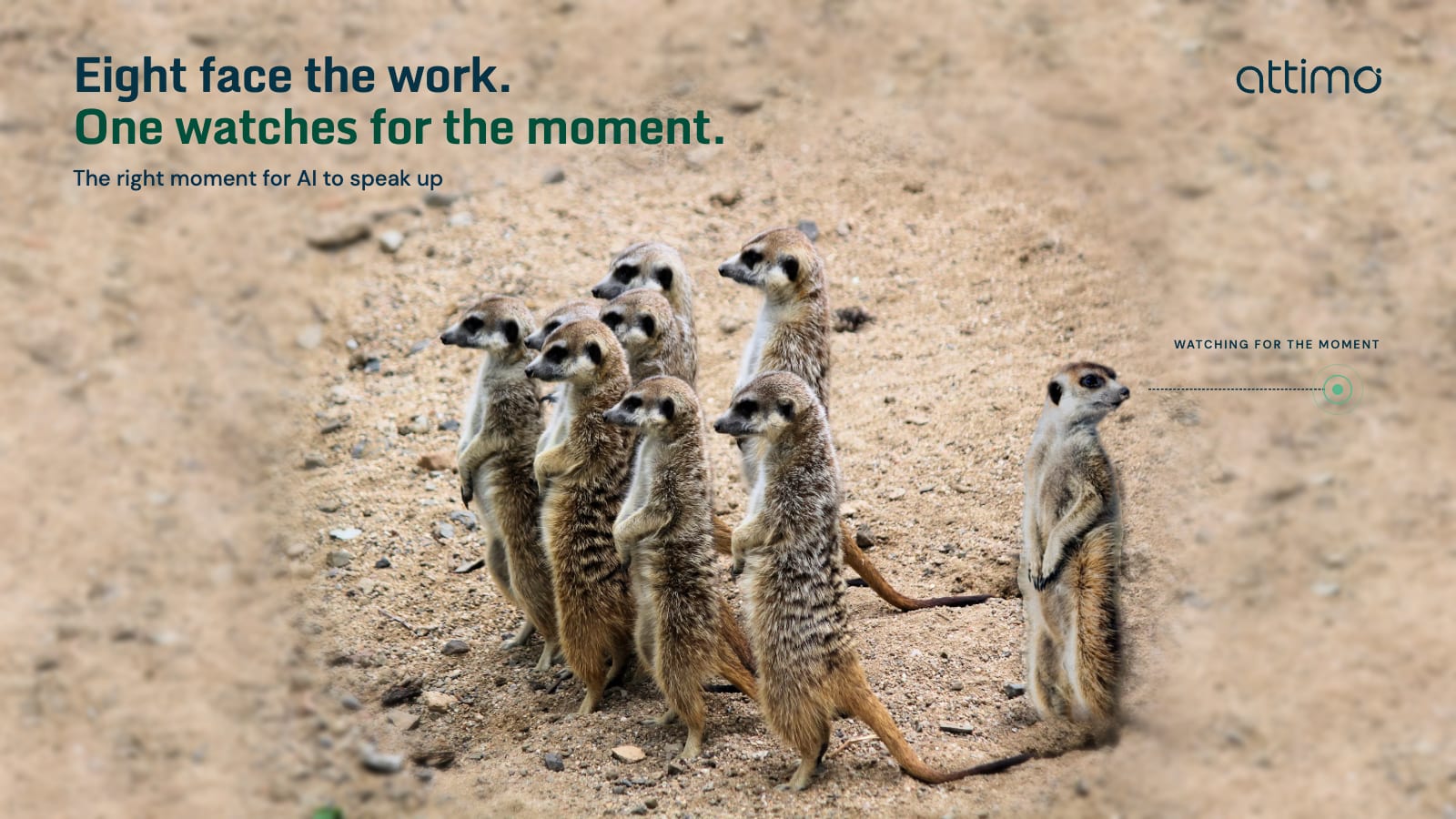
Most of us have worked with someone who has good ideas and poor timing. The suggestion is sound. It arrives just as you are holding six things in your head, and you wave it away without reading it.
AI assistants are now learning to speak up without being asked. Coding tools offer improvements before anyone requests them, writing tools comment on drafts as people type, and agents report back when a task is done. Each of these is a small interruption. Whether it helps depends a great deal on when it lands.
A field study published this year offers one of the clearest pictures yet of what good timing looks like, and the answer is encouraging: get the moment right and people welcome the help.
What the study found
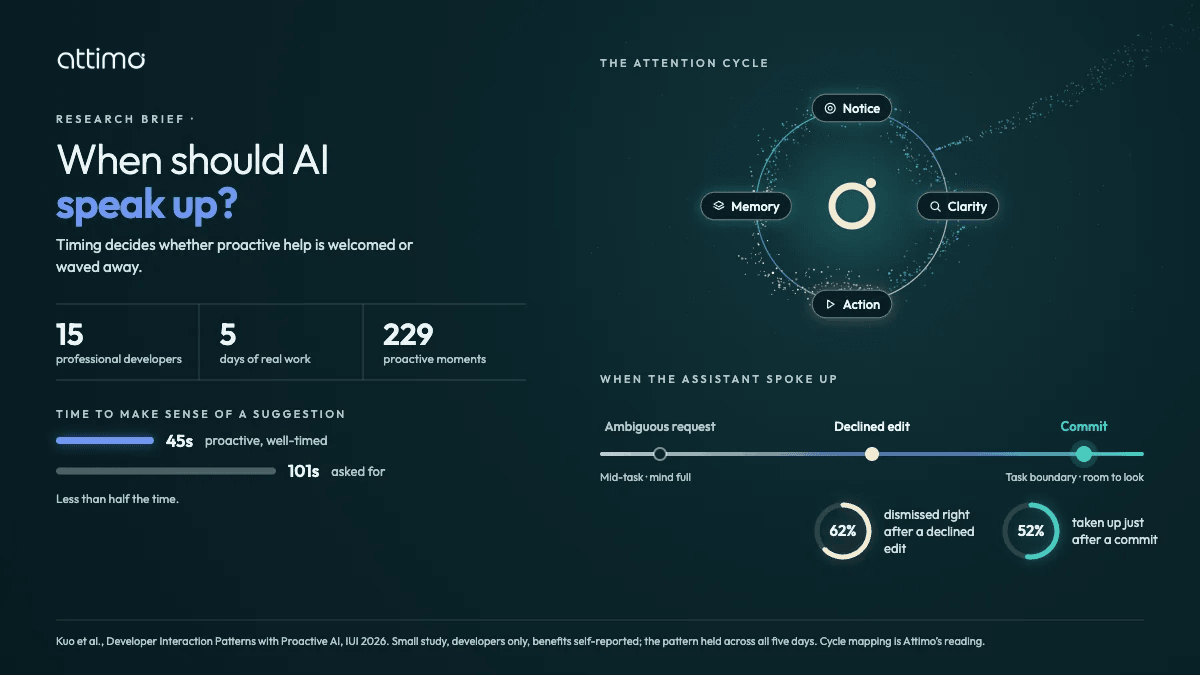
Nadine Kuo and Agnia Sergeyuk of JetBrains, with Valerie Chen of Carnegie Mellon University and Maliheh Izadi of Delft University of Technology, added a proactive feature to a working coding environment. Fifteen professional developers used it in their normal work for five days, and the team logged 229 moments when the assistant offered help unprompted.
The assistant spoke up at three points: when a developer’s request to the AI looked ambiguous, after a developer turned down an AI edit, and after a developer committed finished code.
Timing made a large difference. Suggestions offered just after a commit were taken up 52% of the time. Suggestions offered straight after a developer had declined an edit were dismissed 62% of the time, and one participant said they felt like advertisement. When the timing was right, developers also took less than half as long to make sense of a proactive suggestion as one they had asked for themselves: about 45 seconds against 101.
The study is small and limited to developers using one company’s tools, and the authors are careful to say so. The perceived benefits were self-reported. But the pattern held steady across all five days rather than fading as the novelty wore off.
Source: Kuo et al., Developer Interaction Patterns with Proactive AI, IUI 2026
Why pauses work
The authors connect their results to earlier research by Shamsi Iqbal and colleagues, published in 2005, which found that mental workload drops at the boundaries between tasks. A commit is one of those boundaries. The developer has finished a unit of work and has room to look at it again. Mid-task, the same suggestion competes with everything the person is holding in mind.
Our view at Attimo is that this applies well beyond code. Most work has natural pauses: a drawing set issued, a month-end close completed, a draft sent for review. (These are illustrative examples; the study looked only at software development.) Those are the moments when a second pair of eyes is most welcome.
A field that now takes timing seriously
In June, researchers met at CHIWORK 2026 in Linz for a workshop called TimelyAI, organised around a single question: when should generative AI assistants intervene, if at all? The proceedings were published in September. It is a small sign that timing is becoming a design discipline of its own, rather than a setting left at its default.
Source: TimelyAI workshop proceedings, CEUR Workshop Proceedings, 2026
Mapping timing to the Attention Cycle
At Attimo, we think about intelligent work through the Attention Cycle: Notice, Clarity, Action and Memory. The study’s design principles map onto it closely. (The paper does not use our framework; the mapping is our reading.)
- Notice: choose the moment. Offer help at natural boundaries and keep mid-task signals small. Developers in the study preferred a light cue near where they were working to a chat window opening by itself.
- Clarity: make it readable at a glance. A short title, a reason and a change people can preview before applying it. Participants trusted several small changes more than one large edit.
- Action: leave the decision with the person. Participants valued being asked before the assistant acted. Automatic actions felt intrusive.
- Memory: learn from what people wave away. The authors suggest that records of what developers engaged with and dismissed could teach a system when to speak. Participants also asked for settings to control timing and frequency.
What teams can do now
Good timing may be one of the cheapest improvements available to any team introducing AI. It needs no new model, only attention to how the work actually flows.
Before switching on a proactive feature, ask the people who will use it where the natural pauses in their work are. Then watch what gets dismissed in the first fortnight. Each dismissal tells you something about when help was not wanted, and that is useful information rather than a failure.
A good assistant, like a good colleague, waits until you have put the pen down.
Questions readers may ask
What is proactive AI?
An AI assistant that offers help without being asked, for example by suggesting an improvement when it detects an opportunity. Most AI tools today are reactive and wait for a prompt.
When is the best moment for an AI assistant to interrupt?
In the 2026 field study, suggestions offered at natural task boundaries, such as just after code was committed, were the most welcome. Suggestions offered mid-task were dismissed far more often.
Does this apply outside software development?
The study looked only at professional developers, so its numbers apply to that setting. Our view is that the principle travels: most work has natural pauses, and earlier research on mental workload supports the idea that people have more attention to spare between tasks.
How does this relate to the Attention Cycle?
Timing is the Notice stage. The study’s other findings, about suggestions, keeping people in control and learning from dismissals, line up with Clarity, Action and Memory.