The person who questions an AI recommendation is not necessarily the person holding up the rollout.
They may be the first person taking it seriously.
An operations manager wants to know whether the recommendation uses the latest staffing numbers. A project director asks whether accepting it will alter the approved baseline. A specialist spots an exception that was too ordinary to make it into the documentation.
These are useful questions. A system that cannot accommodate them has mistaken agreement for adoption.
Nervousness contains information
Pew Research Center's 17 September report found that, in 34 of 37 countries surveyed, people were more likely to expect AI to reduce jobs than increase them. These are public expectations, not a forecast of actual employment outcomes.
They nevertheless describe the atmosphere into which workplace AI arrives. The announcement of a helpful new tool does not erase questions about livelihood, status or responsibility.
Those questions also differ. Someone worried about confidential information needs an accurate account of data use. Someone worried about their expertise needs to see where professional judgement still matters. Someone worried about a costly mistake needs to know what the system is allowed to do and how an error will be handled.
“Don't worry” is an unusually small sentence to carry all that work.
What human agency means in practice
Human agency in AI-assisted work means being able to set the purpose, inspect the basis of a recommendation, choose among meaningful alternatives and influence what happens next. It includes the ability to refuse or correct the system within the authority of one's role.
A person can be present in a workflow without having much agency. Consider an approval screen that appears after the consequential action has already happened. Or one that supplies a confident recommendation but hides the source material behind several systems and an access request.
The human has a button. Whether they have a decision is less clear.
Meaningful oversight needs time, information and usable options. Asking someone to accept responsibility without providing those things transfers liability more efficiently than it supports judgement.
Make disagreement useful
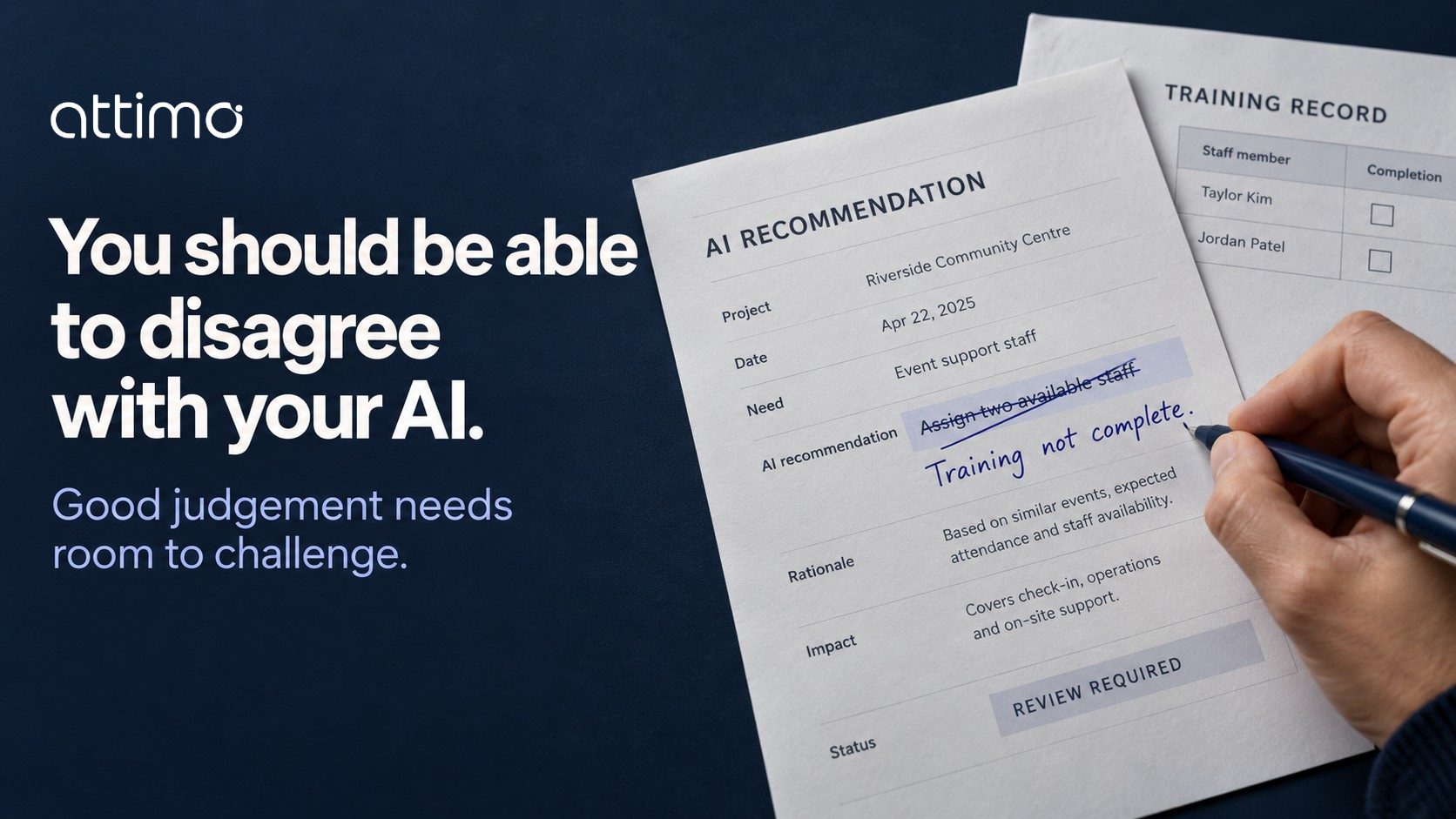
Imagine a service manager reviewing an AI-generated staffing proposal. The plan looks plausible. It misses a training requirement that makes two apparently available employees unsuitable for the shift.
This is an illustrative situation, not a reported case. It shows what a constructive disagreement should accomplish.
The manager should be able to identify the missing condition, attach its source and see which parts of the proposal depend on it. The system should preserve the original suggestion as a suggestion, recalculate where appropriate and make any remaining uncertainty visible.
Simply generating a new answer is insufficient. The user needs to know whether the correction changed the reasoning or merely the wording.
It should also be possible to leave the proposal unresolved. Sometimes the responsible answer is to obtain a missing fact before choosing. A product that treats every pause as failed conversion will make poor decisions about consequential work.
Expertise needs a place to enter
BCG's 24 September study of AI front-runners drew on interviews across 50 companies. Among the changes it describes are clearer outcome ownership, revised decision rights and roles that preserve domain expertise. This is a qualitative study of selected organisations, not a representative estimate or causal trial.
The implication for work design is practical: buying capability does not settle who should direct it.
An experienced employee may recognise that the customer usually needs an extra review, that an apparently spare resource is committed informally, or that a standard process is inappropriate in this case. Some of that knowledge should become explicit. Some requires a conversation. Neither improves if the interface makes challenge feel like vandalism.
There is a commercial opportunity here. A product that makes expert intervention productive can help an organisation use expertise more widely. The person contributes a constraint once, sees its effect and leaves a usable record for the next decision.
This is a much more convincing account of augmentation than telling professionals that AI will free them to be strategic, then giving them a second inbox of outputs to inspect.
Design for an informed objection
Cognitive ergonomics becomes tangible in these small choices. It asks how a system supports attention, understanding and decision-making in the conditions in which people actually work.
Start with the proposition being assessed. What is the system recommending, and what will accepting it change? Put the relevant evidence nearby. Distinguish a recorded fact from an inference and make a missing input visible before it becomes an argument in the meeting.
Then offer meaningful alternatives. Approve, amend, reject and ask for clarification are different actions. They should not be disguised as one cheerful confirmation button.
Finally, preserve the reason for a correction. When the same situation returns, the organisation should have more than a fresh opportunity to repeat the conversation.
None of this means a human should inspect every routine step. Review effort should reflect consequence, uncertainty and the limits of the evidence. A reversible formatting change and a commitment to a customer do not deserve identical ceremonies.
Measure whether people can use the control
Usage figures cannot tell you whether people felt able to challenge the system. A high acceptance rate may reflect excellent recommendations. It may also reflect time pressure or a workflow that makes rejection difficult.
A useful pilot therefore includes a deliberate correction. Give the participant a plausible recommendation with one known constraint omitted. Observe whether they can find the issue, amend the premise and explain the effect. Tell them it is a test scenario, not a genuine operational instruction.
Ask whether they understood what remained uncertain. Check that their decision affected the outcome. Examine whether the record helps a colleague understand the intervention later.
These are proposed evaluation practices, not claims that every organisation must adopt the same test. The essential point is to measure the ability you say the product preserves.
Confidence with reasons
Attimo's belief is that intelligence should increase human capability, not reduce human authorship. We apply cognitive ergonomics to the moments when people need to notice something, understand it, act and retain what they learned.
That belief gives us a demanding design standard. A person should come away better able to explain the work and own the consequences, including when they chose a different path from the one the system suggested.
The best answer to hesitation is an experience that earns a carefully considered yes.
That experience must also make room for no.
Questions readers may be asking
What is contestable AI?
In this article, contestable AI means an AI-assisted process in which an authorised person can inspect and challenge a recommendation, contribute contrary evidence and obtain a meaningful response. An explanation alone does not establish that ability.
Does human oversight require approving every AI action?
No. Review should be proportionate to the action's consequence and uncertainty. Routine work can operate within agreed limits; consequential commitments need the relevant authority and evidence.
Can training resolve resistance to AI?
Training can address unfamiliarity. It cannot, on its own, resolve unclear data practices, missing decision rights or a product that prevents meaningful correction.