For years, using software began with a small act of obedience. Open the application. Find the right menu. Learn what the system calls the thing you want to do.
That arrangement is beginning to loosen.
A question can produce an interactive screen. Work can begin in a conversation and finish in an existing document. An image can become a space a person explores from another angle. These developments are different, but they challenge the same habit: treating the application as a fixed place we must enter before anything useful happens.
Software may become less like a destination and more like a material from which an experience is made.
The screen can follow the question
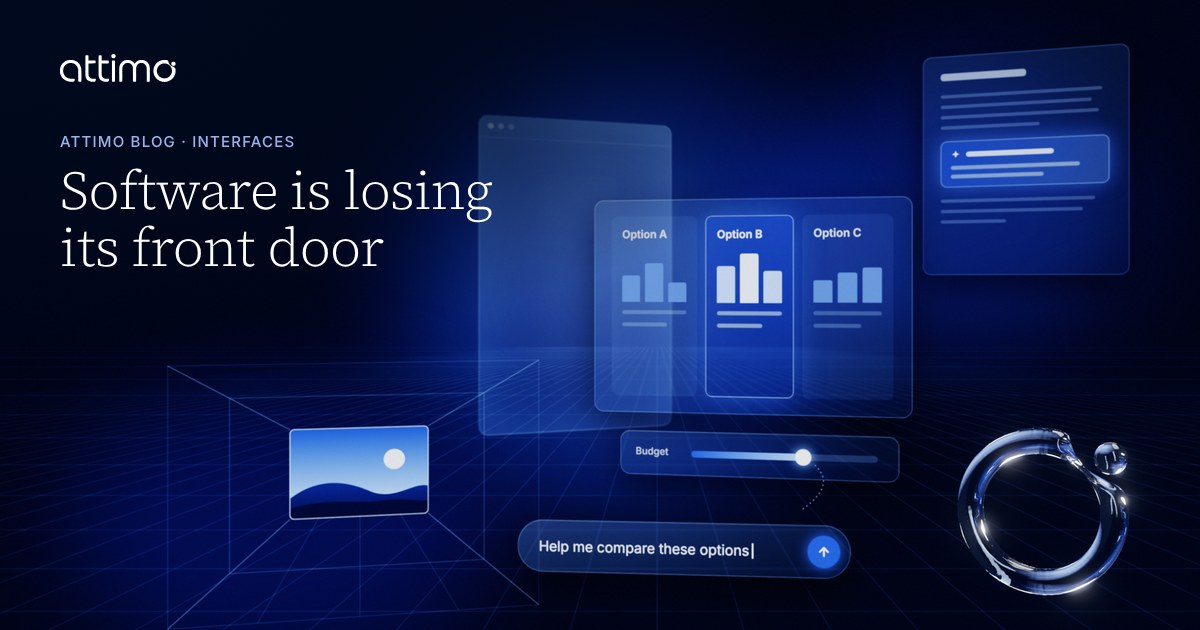
Generative UI means an interface is assembled for the task, rather than every task being fitted into a predetermined screen. A comparison might become a table with adjustable inputs. A question about a mechanism might become an interactive illustration.
An 8 October preprint, When Interfaces Speak, studies generated interfaces for database-backed workflows. Its benchmark is narrow and its findings are early. It demonstrates a concrete research direction beyond answering everything in prose.
This changes what a user can ask for. “Help me compare these options” need not mean six paragraphs about them. It can mean something the person manipulates, so a change in one assumption becomes visible across the comparison.
The possibility is particularly attractive for work that resists a permanent form. A short-lived negotiation or an unusual design question may need its own arrangement of information. Building that arrangement used to be an undertaking in itself.
A tool that appears to fit the thought can make a difficult question feel approachable. There is value in that experience before anyone calculates how many minutes it saved.
The application can come to the work
Google Cloud's 8 October Gemini-agent announcement describes work beginning in a prompt window and returning into documents, inboxes and developer environments. This is Google's product proposition, not an independent assessment of performance.
The broader design possibility is worth examining. A person might remain in the environment where the work already has meaning, while the system assembles assistance around it.
Think about a producer preparing an exhibition. The starting point might be the floor plan, the programme or a conversation with the curator. Requiring the producer to translate that beginning into a software category is a choice about who performs the adaptation.
As assistance becomes embedded, that adaptation can move towards the system. There could be more continuity between thinking about the work and doing it.
Specialist applications will retain value. But the development opens a more interesting question than which assistant gets the largest chat window: where should the experience begin?
A picture can become a place
World Labs introduced Atlas on 1 September. Its demonstrations include generating new views and reconstructing scenes from images. The company explicitly describes how unobserved regions can be imagined. These are vendor demonstrations; a generated space is not an engineering survey.
For creative work, that distinction leaves plenty of room for excitement. A set designer could explore an atmosphere. A filmmaker could consider a camera path. A team could discuss a place while looking into it rather than pointing at a flat picture.
The shared object of the conversation changes. People can begin discussing movement, proximity and perspective earlier. The medium invites a different kind of thought.
Spatial models are not another name for project planning. Their contribution is making certain possibilities perceptible. That can be valuable before the organisation knows which possibility it wants to pursue.
The visible market is only part of the market
The October a16z consumer-app report adds spending to its traffic rankings. Desktop products and agents within messaging channels complicate what web visits can reveal. It uses selected panels; a16z is an investor with commercial interests.
A product may be valuable without asking someone to visit its website every morning. The useful encounter might happen in a file, a message or a temporary workspace.
That possibility should affect what we build and what we count. Visits tell us about one kind of arrival. They cannot describe the whole experience of software that reaches people elsewhere.
A more hospitable kind of software
At Attimo, cognitive ergonomics concerns how technology fits attention and thought. The changing interface gives that ambition new material.
Some work needs a diagram. Some needs a conversation. Some needs a room people can look around. Some needs a simple list and no further ceremony.
The opportunity is to choose the form that suits the task. A generated interface should earn its existence by making something easier to explore or accomplish. It does not need to turn every answer into a small theme park.
Software's front door is becoming less fixed. The more interesting design question is what we can make welcoming once people arrive.
Questions readers may be asking
What is generative UI?
An interface assembled or generated for a task, using controls, comparisons or visualisations instead of relying only on a fixed screen or text answer.
Will AI replace conventional applications?
These developments offer additional ways to interact with software. They do not establish that specialist applications or stable interfaces will disappear.
How is spatial AI different?
It concerns representations of environments and spatial relationships. Generative UI concerns the interaction surface. Products can use either, both or neither.