There is a new kind of professional awkwardness.
Someone presents a polished answer. The reasoning looks sound. The language is confident. Then a colleague asks a simple question: “Why?”
The room becomes unexpectedly interested in its coffee.
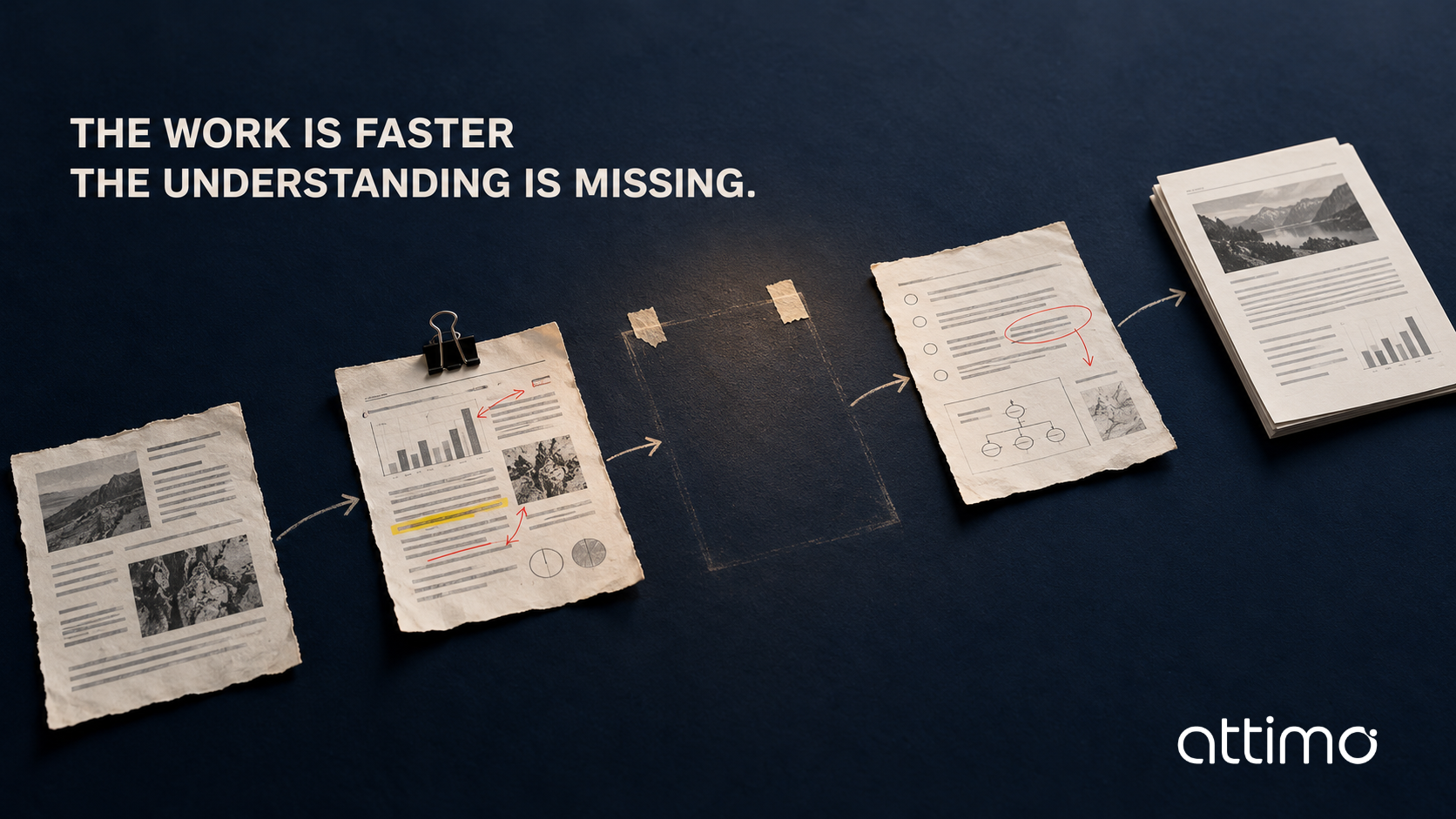
This is not proof that AI makes people less intelligent. It is evidence of a design problem. Generative AI can help us produce an answer before we have completed the slower work of understanding it.
Researchers have begun to give this gap a useful name: epistemic debt.
What is epistemic debt?
In an August 2026 commentary in Nature Machine Intelligence, researchers described epistemic debt as the gap that opens when people use generative AI for cognitive tasks without investing enough effort to understand and verify the output. As later work builds on that output, the gap can compound.
The idea is a conceptual argument, not a measured law. Its value lies in the pattern it names.
Technical debt lets a system move quickly by postponing engineering work. Epistemic debt lets a person move quickly by postponing understanding. Both can be rational in small amounts. Both become dangerous when nobody records what has been deferred.
The debt may surface when:
- an employee cannot explain the assumptions behind an AI-produced recommendation;
- a manager approves a summary without inspecting the evidence it excluded;
- a team reuses an answer whose original context has disappeared;
- a confident draft becomes an organisational fact before anyone owns the judgement.
The problem is not AI assistance. It is assistance that conceals where cognition has been removed.
Cognitive offloading is not the enemy
Humans have always offloaded mental work. We write lists, build spreadsheets, use maps and ask colleagues who remember the meeting better than we do. Civilisation would be considerably less civil without external memory.
Good tools reduce unnecessary cognitive load so that attention can move to judgement, creativity and action. Cognitive ergonomics asks whether the information environment fits the way people perceive, decide and remember.
Recent research shows why this matters. A 2026 study of AI-assisted post-editing used eye tracking, key logging, subjective ratings and interviews to examine how people worked with machine-generated text. AI assistance reduced overall cognitive load in some tasks, but increased concentrated effort at important decision points.
The researchers called this a cognitive paradox. AI did not simply remove thinking. It redistributed it.
That is exactly what well-designed assistance should do. The machine handles routine comparison or drafting. The person spends more attention where context, ambiguity and consequence require judgement.
The design failure occurs when a system removes effort from the wrong place.
Friction can be functional
Most software treats friction as an enemy. For repetitive administration, this is sensible. Nobody has ever asked for a more contemplative expense form.
But some friction protects quality. A surgeon pauses before an incision. A pilot confirms a critical change. An editor checks the source behind a surprising claim. These moments slow action because the cost of fluent error is high.
AI products need a more discriminating view of ease.
The question is not, “How can every interaction require fewer clicks?” It is, “Where should effort disappear, and where should attention intensify?”
Routine friction includes reformatting, searching, comparing versions and transferring information between systems. Consequential friction includes testing assumptions, weighing trade-offs, checking provenance and accepting accountability.
An intelligent interface should reduce the first and preserve the second.
Five ways to prevent epistemic debt
1. Keep the source beside the claim
A citation hidden behind a confidence score is not enough. People need to see what evidence supports a claim, how current it is and whether the system inferred something beyond it.
Provenance should be part of the working surface, not an appendix assembled after the decision.
2. Ask for a decision, not passive acceptance
“Approve” encourages a binary response. Better interaction asks what the user accepts, rejects or changes, and why.
This small act converts output consumption into active judgement. It also creates a record that can be examined later.
3. Preserve friction at consequential moments
Not every AI suggestion needs a ceremony. High-impact recommendations do need a checkpoint proportionate to their consequence.
A useful system can distinguish between reversible drafting and decisions that affect people, money, safety or future commitments.
4. Separate fluent language from evidential strength
Generative systems are exceptionally good at making weak material readable. The interface should not allow polish to masquerade as proof.
Show uncertainty, contradictory evidence and missing context clearly. Good judgement begins where the answer stops looking inevitable.
5. Store the reasoning with the outcome
If an organisation saves only the final artefact, future users inherit the answer but not the understanding.
Capture the question, the sources, the alternatives considered and the human decision. This converts an AI interaction from disposable output into organisational memory.
Attimo helps organisations design AI-assisted work around attention, judgement and memory. Explore our approach
Design for better thinking, not just more output
Microsoft Research has made a related case for AI as a tool for thought: technology that helps people think more clearly, deeply and creatively rather than merely accelerate production.
Its 2026 field experiment with 388 employees also offers a warning against simplistic prescriptions. The same AI system produced different effects when the surrounding instructions changed. A behavioural protocol that required paired collaboration was associated with lower quality and much lower production, while a cognitive prompt that framed AI as a thought partner was associated with stronger work among top-performing documents. The researchers rightly noted limitations, including timing differences, attrition and reliance on model-based scoring.
The conclusion is not that one prompt solves work. It is that the design around the model changes what the model does to the person.
This is the domain in which Attimo works. We apply cognitive ergonomics to AI-assisted work so that useful information becomes noticeable, understandable and actionable, then remains available as organisational memory. The aim is not to make people supervise a machine all day. It is to make the right moments of human judgement visible and well supported.
AI should make work lighter. It should not make knowledge hollow.
The best system is not the one that gives a person nothing to think about. It is the one that gives them the right thing to think about, at the right moment, with enough evidence to own what happens next.
Frequently asked questions
What does epistemic debt mean?
Epistemic debt is the widening gap between an answer a person can produce with AI and the understanding they can use to explain, verify or defend it. The concept is especially relevant when later decisions rely on earlier AI-assisted work.
Is cognitive offloading harmful?
No. Tools have always helped people offload memory and routine calculation. The risk appears when a tool removes attention from consequential judgement or hides the evidence needed to evaluate an answer.
What is cognitive ergonomics in AI?
Cognitive ergonomics designs tools and work around human attention, perception, memory and decision-making. In AI systems, it asks which effort should be automated, which judgement should remain human and how the interface should support that distinction.
How can organisations reduce epistemic debt?
Keep sources visible, distinguish evidence from inference, introduce proportionate review at consequential moments, record the human decision and preserve the reasoning with the final output.
Sources
- Nature Machine Intelligence“The epistemic debt of generative AI”Nature
- The Hong Kong Polytechnic University“Assistance or Distraction? A Cognitive Ergonomics Perspective on Cognitive Load During AI-Assisted Post-Editing”PolyU
- Microsoft Research“Better Thinking Through AI”Microsoft Research
- Microsoft Research“A Field Experiment on Human-AI Collaboration”Microsoft Research