A prospective client arrives at your digital doorstep asking for a niche service your company phased out many months ago. Why? A chat assistant casually assured them you still offer it. Somewhere in the dusty corners of your website, a forgotten landing page is still dutifully feeding stale facts to eager web crawlers.
This is a classic tale of modern digital friction, yet it points to a very real operational blind spot. When an automated engine misrepresents your business, who actually owns the truth? Who steps up to correct the record, update the source and ensure the hallucination does not linger?
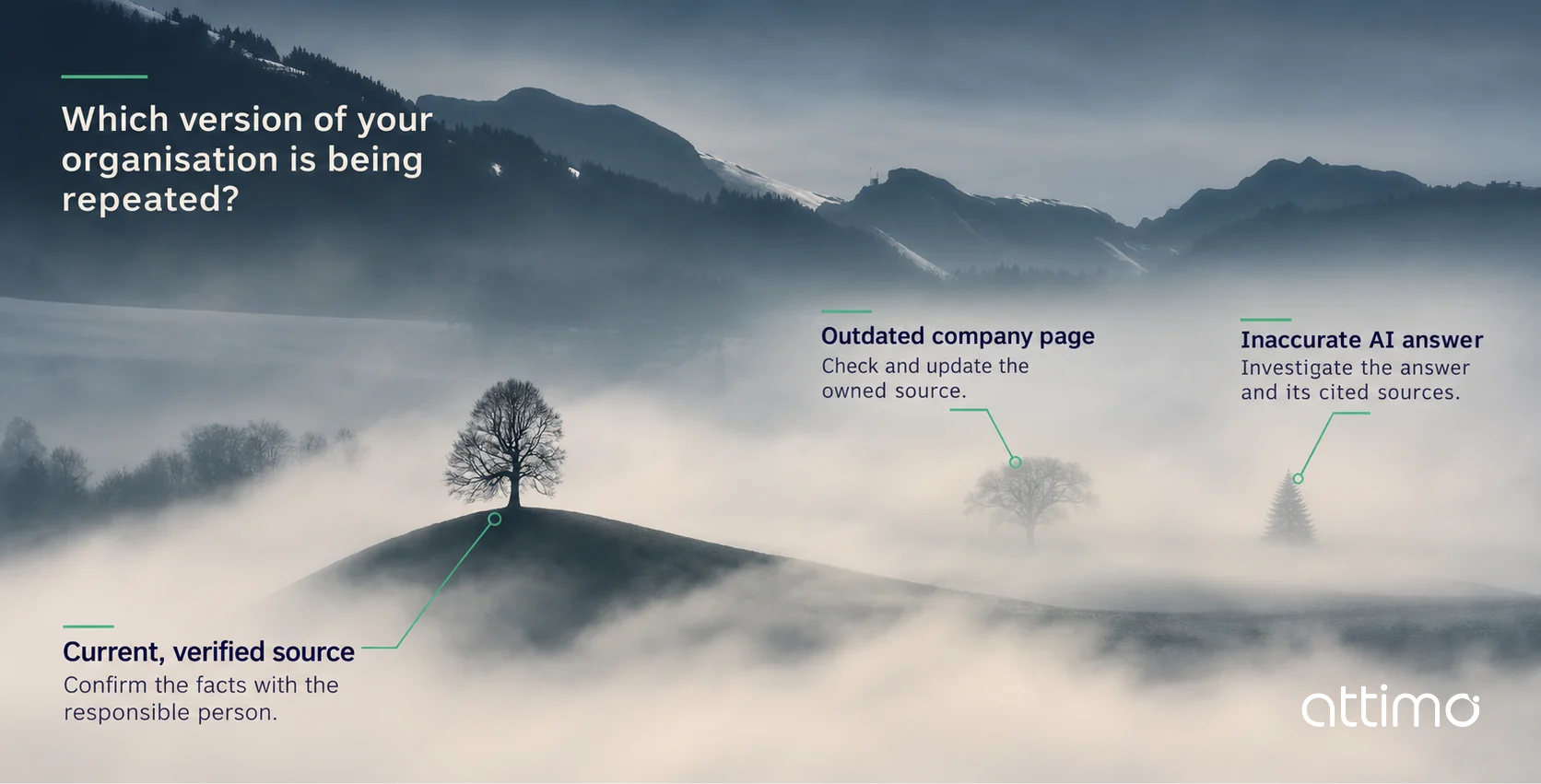
At Attimo, we suggest turning your attention to the underlying claim itself. Capture what the system is saying, gather the evidence that refutes it and hand the corrective pen to the colleague who owns that domain. Then, measure the outcome because updating a webpage offers no magical guarantee that every language model will immediately change its mind.
A new job around an existing responsibility
On 9 November, Gartner published survey data revealing that 42% of chief marketing officers had actively taken steps to monitor and correct brand misinformation in generative outputs.
It is worth keeping in mind that this reflects reported corporate activity rather than measuring how often language models stumble, nor does it guarantee which remediation techniques work.
Yet the core challenge extends far beyond marketing. If a chatbot misstates a service's availability, the person with the real answer likely sits in operations. If it invents a feature you have never built, product managers hold the ground truth. Marketing may publish the statement, but subject experts must first establish what is actually true.
In short: fixing AI hallucinations is a knowledge management task with very public consequences.
Establish which kind of error you have
Consider our discontinued service example. If the old landing page remains live without context while your main navigation omits it, your business has altered its catalogue without giving legacy content a clear status tag. That is an internal housekeeping error.
Now picture a trickier scenario: every single page on your site is immaculate, yet an external model creatively stitches together two unrelated product descriptions, inventing a hybrid service you have never offered. That is an external synthesis error.
The distinction matters immensely:
- Internal gaps require cleaning up your owned web properties.
- External confusion requires investigating machine output, checking citation sources and using formal feedback or reporting routes.
Treating both as the same problem leads to restless re-writing of accurate content while the real source of confusion goes unaddressed.
Keep a lean logbook. Document the prompt, the exact output, the date and the specific engine used (along with any sources cited). Preserve just enough context so a colleague can replicate your check without having to reconstruct the scene of the crime.
| Error Type | Primary Cause | Immediate Action Required |
|---|---|---|
| Internal Housekeeping | Legacy web pages, conflicting dates and orphaned URLs | Update owned content, archive old pages and set explicit status |
| External Synthesis | Model hallucination, third-party press and scraper misinterpretation | Audit citations, submit platform feedback and strengthen structured data |
Give a correction somewhere to land
For any commercial claim that matters, assign a named human owner. That individual should be able to point to clear, verifiable evidence and articulate any caveats.
Precision is your best ally here:
- Define target audiences explicitly: A claim like "available for enterprise accounts" needs clear boundary lines.
- Flag trial features clearly: Explicitly label early trials so algorithms do not mistake a pilot for a flagship product.
- State launch timelines explicitly: Distinguish roadmap features from live tools a customer can use today.
Our suggested working record remains delightfully simple: note the claim, the supporting proof, the designated owner and the operational trigger for review. A product launch, retirement or contract shift makes for a far better review trigger than a generic monthly calendar reminder.
When drafting a correction, state the factual position directly and positively. Repeating an inaccurate rumor (even to debunk it) simply adds ambiguous text to the web for algorithms to misinterpret.
Make the source useful to a reader
According to Google Search Central's guidance on AI features, generative search relies on foundational SEO principles. There are no secret handshakes, hidden tags or magic optimisations required to appear in AI Overviews.
For most organisations, the real work is foundational digital publishing: write crisp service descriptions, maintain clear page statuses and ensure content is easy for humans and crawlers to access. Speculative promises of specialized "AI optimization" won't fix a basic factual gap.
Structure your pages logically. Place direct answers up front before adding qualifications. Where policies change, state the current rules clearly and label archived information with explicit dates.
Check what the correction changed
Once you update an owned source, test the relevant queries again after a sensible interval. Keep your observations grounded: just because an answer changes after a site update doesn't automatically prove cause and effect.
At Attimo, we structure this work using the Attention Cycle:
- Notice: Identify a misleading or inaccurate answer in the wild.
- Clarity: Work out the true facts with the responsible subject expert.
- Action: Update your owned channels with clear, unambiguous copy.
- Memory: Maintain a simple record so you can track and verify changes over time.
Start with a single claim that impacts real customer decisions. Make sure your team can find the supporting evidence and knows who has the authority to update it. That single step builds organizational resilience long before the next AI engine generates its next answer.
Questions readers may ask
Can a business control every AI answer written about it?
No. You cannot control third-party models directly, but you can refine your owned content, track inaccuracies systematically and use available platform reporting tools.
Who should own an inaccurate statement?
Factual corrections belong to the subject matter expert who manages that business area. The web publishing team then ensures that approved truth is clearly structured and accessible online.
Read more about Attimo's approach to reliable knowledge and human judgement.