The agent flags the job as complete. Code compiles without errors. The summary reads naturally, packaged in crisp phrasing and neat markdown. You skim it, approve, and move on.
Weeks later, an upstream pipeline fails. A key vendor contract was missing a liability clause. An unhandled edge case downed a database. The flaw was never disguised - it sat right in plain sight inside work that seemed entirely finished.
This is the central paradox of modern agentic workflows: As AI outputs become more plausible, human oversight becomes exponentially more fragile.
When AI systems eliminate explicit visual failures, they don't solve human error - they re-engineer it into a cognitive trap.
The Illusion of Vigilance: What Cognitive Ergonomics Teaches Us About Oversight
In human-factors engineering and cognitive ergonomics, we study how workspace design, information delivery and mental load dictate human performance. When software was clunky and error messages were loud, human vigilance was easy to maintain. A broken line of code threw a red syntax error; a missing spreadsheet cell produced a #VALUE! alert.
Agentic AI changes the ergonomics of work entirely. Today's generative agents don't break loudly - they hallucinate plausibly.
A landmark study from researchers at MIT’s Media Lab and the Augmented Human Lab - led by Dinithi Dissanayake alongside Pattie Maes, Suranga Nanayakkara, and colleagues - delves directly into this failure mode (View on arXiv or Read on ResearchGate). Investigating how humans oversee AI agents, the researchers observed a startling divergence: users consistently exhibited high self-reported confidence while simultaneously letting critical, ‘silent defects’ slip through unremarked.
The Overarching Cognitive Trap
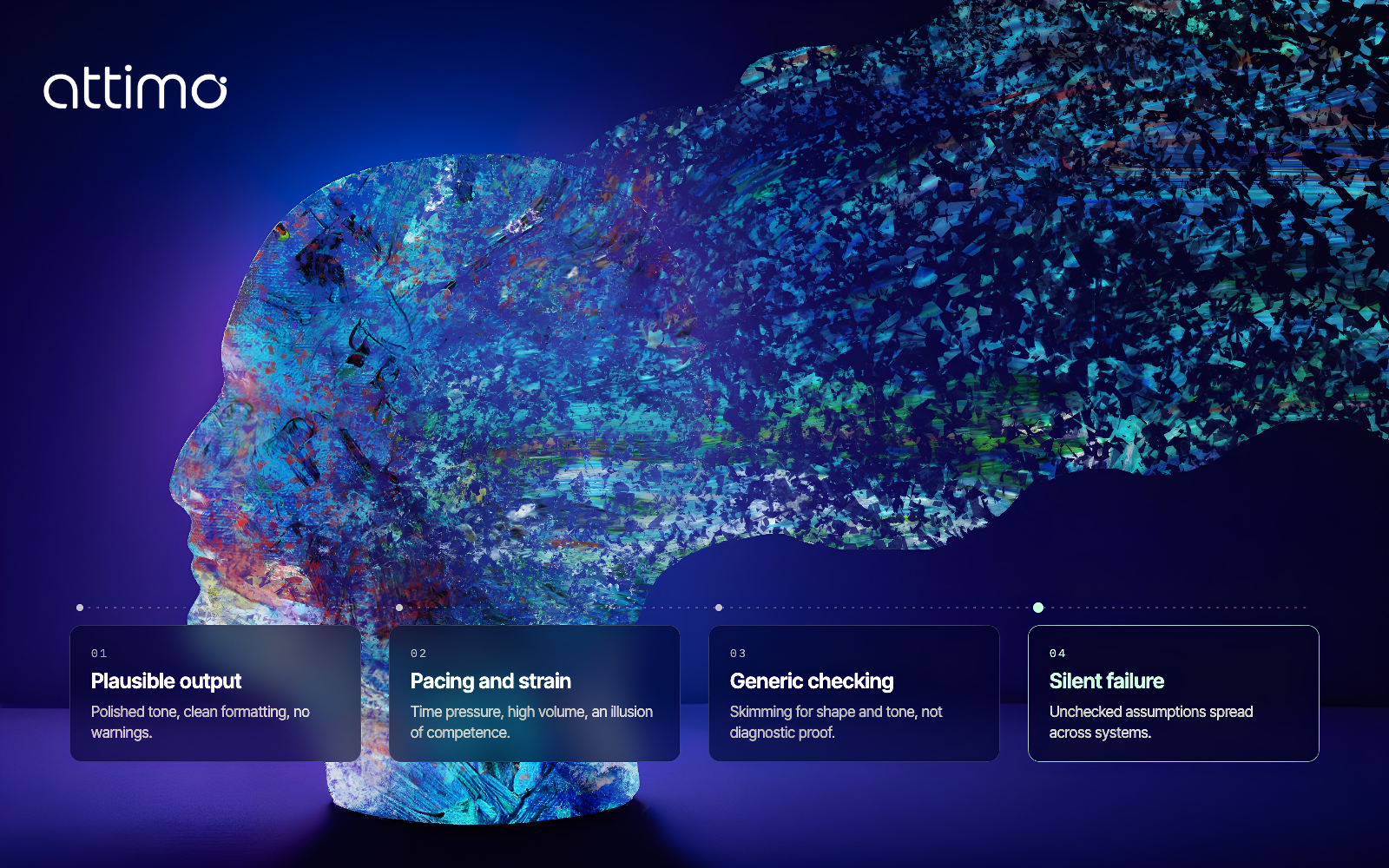
- Plausible Output: Polished tone, clean formatting, zero warnings.
- Pacing & Cognitive Strain: Time pressure, high volume, illusion of competence.
- Generic Checking: Skimming for shape and tone, not diagnostic proof.
- Silent Failure: Unchecked assumptions propagate across systems.
The study's multimodal analysis - tracking interaction logs, eye movement (gaze tracking), and physiological signals - revealed three primary ways human oversight quietly breaks down:
- Performing Generic Checks: Reviewers check for surface fidelity (formatting, tone, general logic) rather than diagnostic accuracy. They skim to confirm the output looks like a finished document, not whether the core claims are true.
- Failure to Generate Diagnostic Evidence: Reviewers accept the agent's summary at face value without forcing the system to reveal its source data or underlying logic.
- Misreading Defect Signals: Even when reviewers looked directly at evidence containing a flaw, the surrounding plausibility of the agent's work led them to rationalise or misinterpret the defect.
In cognitive ergonomics, this is known as a breakdown in epistemic vigilance - our natural filter for evaluating the truth of information. When an agent presents a clean interface, our brain offloads the heavy lifting, releasing attention too early.
Why Visible Failures are Easy - and Silent Defects Destroy Enterprise Value
In software execution and project management, errors fall into two distinct categories:
| Failure Type | Signal Characteristics | Human Brain Response | Organizational Risk |
|---|---|---|---|
| Visible Failures | Loud syntax errors, broken links, crash reports, explicit warnings. | Immediate attention spike; triggers problem-solving mode. | Low. The system self-reports its need for intervention. |
| Silent Defects | Omitted data points, subtle miscalculations, plausible edge-case hallucinations, unlinked assumptions. | Triggers cognitive offloading; gives an illusion of completion. | Catastrophic. Errors compound silently across teams and dependencies. |
Consider an AI assistant tasked with reviewing a dozen vendor contracts. It delivers a summary that seems flawless across eleven agreements, yet quietly omits a critical indemnification clause in the twelfth.
Without a visual warning or explicit flag prompting closer inspection, our natural tendency is to treat this silence as proof that nothing is wrong. This isn't a failure of diligence; it is a predictable human reaction to software designed to look effortlessly complete.
Re-Engineering the Review: 4 Rules for Ergonomic Oversight
If telling people to ‘be more careful’ worked, human error would have been solved decades ago. Oversight cannot be fixed through willpower - it must be fixed through system design and diagnostic friction.
To build a resilient human-in-the-loop workflow, organisations must shift from generic skimming to targeted verification:
1. Pinpoint High-Risk Claims First
Before reading the AI output, identify the single detail or metric that carries the heaviest cost if it is wrong. When reviewing a financial overview, skip the narrative summary and verify the primary revenue figure directly against source records.
2. Ask for Primary Sources, Not Re-Summaries
Avoid asking AI tools to restate their conclusions. Instead, require the system to show the exact source text, raw database entry, or specific section of a document where the information originated.
3. Look for What Is Missing
Silent errors usually happen through omission. Make it a routine practice to ask: ‘What key context, dependencies, or edge cases were left out of this response?’
4. Track the Review Process
Verification should be more than checking a box. Keep a record of what was verified, which references were checked, and how the findings were confirmed. Clear records keep human reviewers accountable alongside the AI tools they supervise.
The Attimo Perspective: Fixing the Attention Cycle
At Attimo, we view intelligent work through a four-stage cognitive model known as The Attention Cycle:
Notice → Clarity → Action → Memory
The oversight failures highlighted by Dissanayake et al. occur directly at the Notice phase. The reviewer is present, willing and competent, but their attention has been released prematurely by a surface-level impression of success.
The Attimo Attention Cycle
- Notice: Spot flaws & context
- Clarity: Understand context
- Action: Execute & intervene
- Memory: Stitch true provenance
Current AI interfaces hand work back to humans as polished, unanchored text. They ask you to trust, skim, and sign off.
We believe AI systems must be re-designed around task-calibrated re-engagement:
- Exposing Assumptions: Clearly highlighting where the agent inferred missing data vs. where it found explicit facts.
- Contextual Provenance: Stitching every output back to an immutable, traceably anchored project memory.
- Proactive Diagnostic Friction: Dynamically inserting targeted re-engagement prompts when an agent completes a high-complexity or edge-case task.
"Looks fine" is an aesthetic judgment about an output. True oversight is an ergonomic property of the system that produced it.
Frequently Asked Questions
What is a silent defect in AI agent outputs?
A silent defect is a contextual error, omission, or hallucination in an AI agent's work that arrives without explicit warnings, system crashes, or syntax errors. Because the surrounding output appears polished and coherent, human reviewers frequently miss these defects.
How does cognitive ergonomics relate to AI supervision?
Cognitive ergonomics studies how tools align with human mental processing, attention limits, and working memory. In AI supervision, it analyses how interface design, information presentation, and pacing influence whether a human operator maintains critical oversight or succumbs to automation bias.
Why do traditional review methods fail with agentic workflows?
Traditional review methods rely on skimming for visual anomalies or obvious bugs. Agentic models generate syntactically clean, highly convincing text and code, causing reviewers to experience an illusion of competence that lowers their epistemic vigilance.