In a technical meeting, a familiar English word can be the least foreign thing in the room.
A team may discuss the project in French, write its specification in English and use a particular equipment term in German. The vocabulary follows the work. A perfectly translated paragraph can become harder to use if it replaces the term everybody knows.
AI translation makes that distinction worth examining. It offers more ways for people to encounter specialist material in a language they understand comfortably. The useful question is how to extend that access without making the specialist content unfamiliar.
When translation becomes too thorough
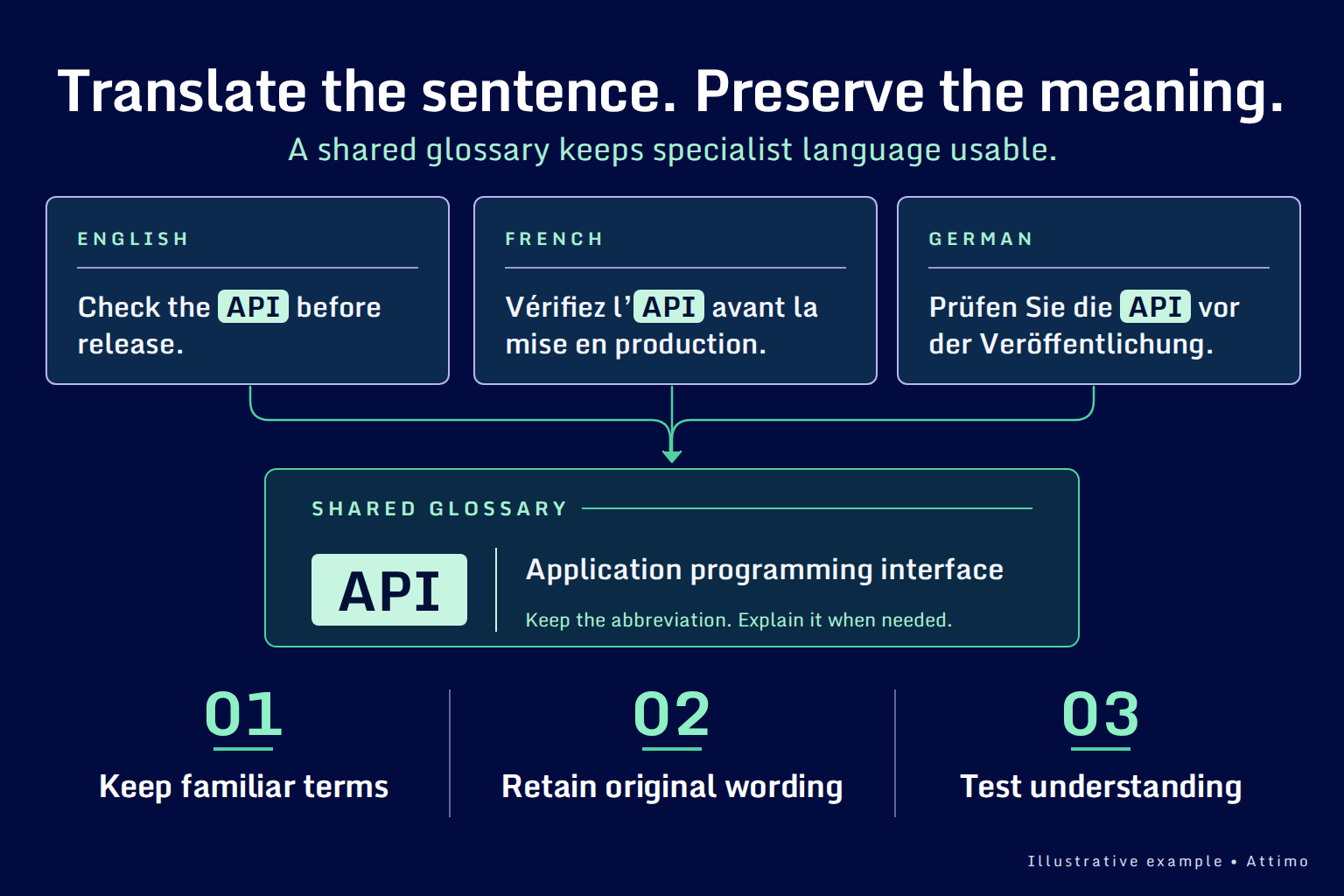
In a paper published in Findings of EACL 2026 in March, Hannah Calzi Kleidermacher and James Zou described translating scientific papers into 28 languages. Their user study involved 15 researchers reading their own work in their native languages. A third objected to technical terms being overtranslated, preferring familiar English terminology in some places.
This is a small study of scientific papers, rather than an evaluation of multinational workplaces. Its observation is nevertheless useful: the most natural general-language translation may not be the most usable professional one.
Imagine an engineering supplier and its customer discussing a test procedure. The supplier's catalogue, equipment labels and training material all use the same component name. Translating that name differently in a meeting summary may create an extra identification task for everyone reading it.
This is an illustrative example. The design requirement is concrete: let the reader connect the translated account to the objects and documents they actually use.
Language is part of the task
A September paper in Scientific Reports tested three language models across 12 languages. Performance on its comprehension tasks varied by language, and English was not consistently the strongest. The finding concerns those models and tasks; it does not produce a permanent league table of languages.
For a product team, it is a reason to test the languages people will use. Translating an interface after evaluating only its English version leaves an important part of the experience unexamined.
The test should include the work's own vocabulary. Can a reader distinguish an estimate from a commitment? Can they identify the correct piece of equipment? Do they understand the action expected of them? A fluent sentence can still leave those questions open.
Preserve the terms that help people work
Start with a short shared glossary for one workflow. Ask the people doing the work which terms should remain unchanged, which need a local equivalent and which need both. Include abbreviations, product names and phrases whose ordinary meaning differs from their professional meaning.
Keep the original wording available where a consequential distinction rests on it. Give people a way to flag a translation that is grammatically sound but operationally strange. Review the glossary when a new supplier or discipline joins the work.
These are practical design proposals, rather than outcomes established by the studies. They make language a subject for user testing instead of treating translation as a finished administrative step.
Participation is the opportunity
Someone reading in a second language may understand the problem deeply while needing longer to formulate a response. A translated pre-read could give them more room to contribute. A familiar technical term could help them connect that response to the shared work.
The ambition is greater participation in a demanding conversation. That requires attention to the material people are trying to understand and the language in which they can contribute most precisely.
At Attimo, cognitive ergonomics includes this relationship between the person, the task and its presentation. A system should help expertise enter the conversation. It should also respect the vocabulary in which that expertise lives.
Explore Attimo's perspective on intelligent work
Questions readers may ask
What is overtranslation?
In this context, it is translating a specialist term that readers would find more familiar or useful in its original form.
Should technical teams always work in English?
The research cited here does not establish one best language for every team. Choose and test language support around the people and the task.
How can a team evaluate AI translation?
Use representative material, involve domain specialists and test whether readers can correctly interpret and act on it. Fluency alone is an incomplete test.